How to Identify UK Herons and Egrets: A Beginner's Field Guide
A grey heron on a village pond is one of the easiest birds in Britain to recognise. Then a slim white shape stalks across the shallows, or a big pale bird flaps low over the reedbed, and suddenly nothing seems simple. Herons, egrets, bitterns and their allies all share the same basic blueprint: long legs, long necks, dagger bills and a taste for fish, frogs and anything else they can swallow. The trick is knowing which details matter.
Work through this guide in the order it is written. Get the size and shape right first, then check the plumage, then watch what the bird is doing and where it is doing it. In practice, most UK heron family birds can be pinned down in a few seconds once you know what to look for.
Start with size: your first big clue
Size and proportions narrow things down faster than colour, especially when light is poor or a bird is half-hidden among reeds.
- Grey heron: big, roughly goose-sized on long legs. Your default large heron.
- Little egret: about half the bulk of a grey heron. Neat, slender, almost dainty.
- Great white egret: closer to grey heron size, but with a noticeably longer neck and longer bill.
- Cattle egret: small and compact, hunched rather than elegant.
- Bittern: grey heron-sized but secretive, usually buried in reeds.
Check the bird against whatever is nearby. A little egret beside a grey heron looks almost comically small once you have the two in the same binocular view, and that comparison alone will settle the identification.
Grey herons: the familiar benchmark
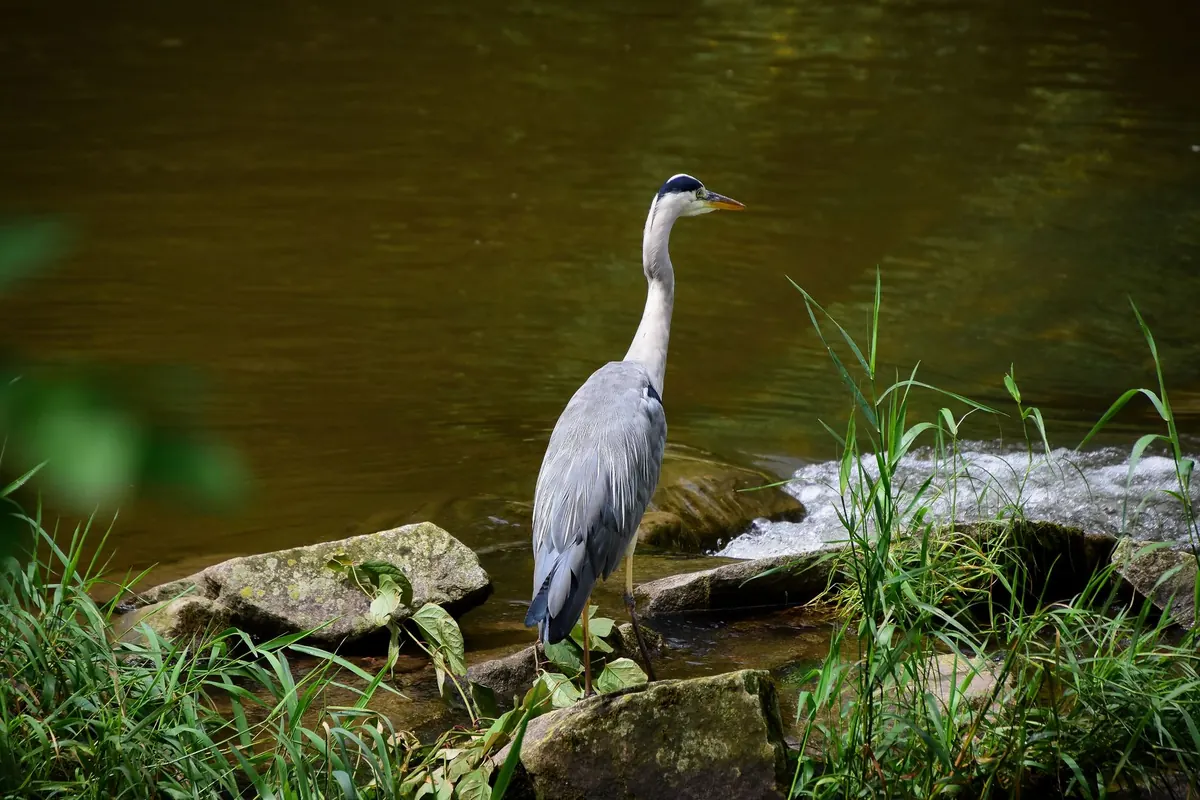
Learn the grey heron properly and everything else becomes a variation on a theme. Adults are grey with a white head and neck, a black stripe running from the eye to the back of the crown, and a stout yellowish bill. In flight the wings are broad with black tips, and the long legs trail well beyond the tail.
Grey herons are found on almost any water: garden ponds, canals, gravel pits, estuaries and wet fields. You may also see them perched in trees, which surprises people who expect them to be strictly aquatic. Listen for the harsh, croaking fraaank they often give as they lift off, usually before they leave your field of view.
Little egrets: white, slim and busy
Little egrets are now widespread across much of England and Wales, and increasingly familiar further north. Look for a small, pure white heron with a long black bill and, crucially, black legs with bright yellow feet. Those golden toes are the giveaway on a standing bird, though they vanish when it is wading in mud or deep water.
Behaviour helps too. Little egrets are active hunters, often shuffling their feet or dashing sideways to stir up small fish and shrimps. Great white egrets tend to be more stately, holding their position and striking deliberately. If a white heron is chasing its own reflection around a muddy pool, it is almost certainly a little egret.
Great white egrets: the stately newcomer
Great white egrets are much rarer than little egrets, but they turn up more often each year at wetlands, reservoirs and coastal marshes. They are best described as a white grey heron with ambition: taller, longer-necked and with a yellow bill that looks like an oversized javelin.
In full view the bill colour separates the two common white egrets neatly, while the size difference does the rest. A great white egret in flight recalls a grey heron in its slow, heavy wingbeats rather than the quicker action of a little egret.
Cattle egrets, bitterns and night herons
Cattle egret
Cattle egrets are small, stocky white herons, usually seen in the south-west and south of Britain. As the name suggests, they follow livestock to snap up insects disturbed by hooves, often feeding in grassland rather than water. In breeding plumage they show buff-orange patches on the crown, breast and back.
Bittern
Bitterns are large reedbed specialists that prefer to hide rather than parade. You will usually hear one before you see one: the deep, booming call carrying across a marsh in spring is one of the most remarkable sounds in British wildlife. Most sightings are of a brown, streaked bird lifting briefly above the reeds before dropping back out of sight.
Night heron
Night herons are compact and short-necked, with a black crown and back, grey wings and a hunched posture. They are most active at dawn and dusk, and rare enough in Britain that any sighting is worth reporting to your county recorder.
Behaviour and habitat tell you plenty
Where a bird is standing, and what it is doing, is often as useful as how it looks. Here is a quick comparison to keep in your head:
- Tight reeds, rarely seen: bittern.
- Dry fields, often with cattle: cattle egret.
- Shallow pools, restless and darting: little egret.
- Open water, tall and deliberate: great white egret.
- Anything wet, anywhere, standing motionless: grey heron, by far the most likely option.
Also note the neck. Little egrets keep the neck fairly short, while great white egrets regularly hold it stretched and slightly kinked, ready to strike.
Practical tips for your next trip
Visit a wetland reserve early in the morning, when birds are feeding and there is little disturbance. Scan the whole scene first with binoculars rather than hurrying to the nearest bird, then check each candidate against the points above. A telescope helps enormously for distant white birds, where leg colour quickly disappears into backlighting.
Keep a notebook and jot down what the bird was doing as well as what it looked like. Time of year matters too: numbers of little and great white egrets rise in autumn and winter, when birds from the continent join our resident population.
Above all, do not overlook the ordinary. Most white herons a beginner sees will be grey herons, and most small white ones will be little egrets. Confirm those confidently, and the rarer species will stand out all the more clearly when they appear.
Photo: Joerg Hartmann / Pexels