Beginner's Guide to Birdwatching Binoculars: What to Look For
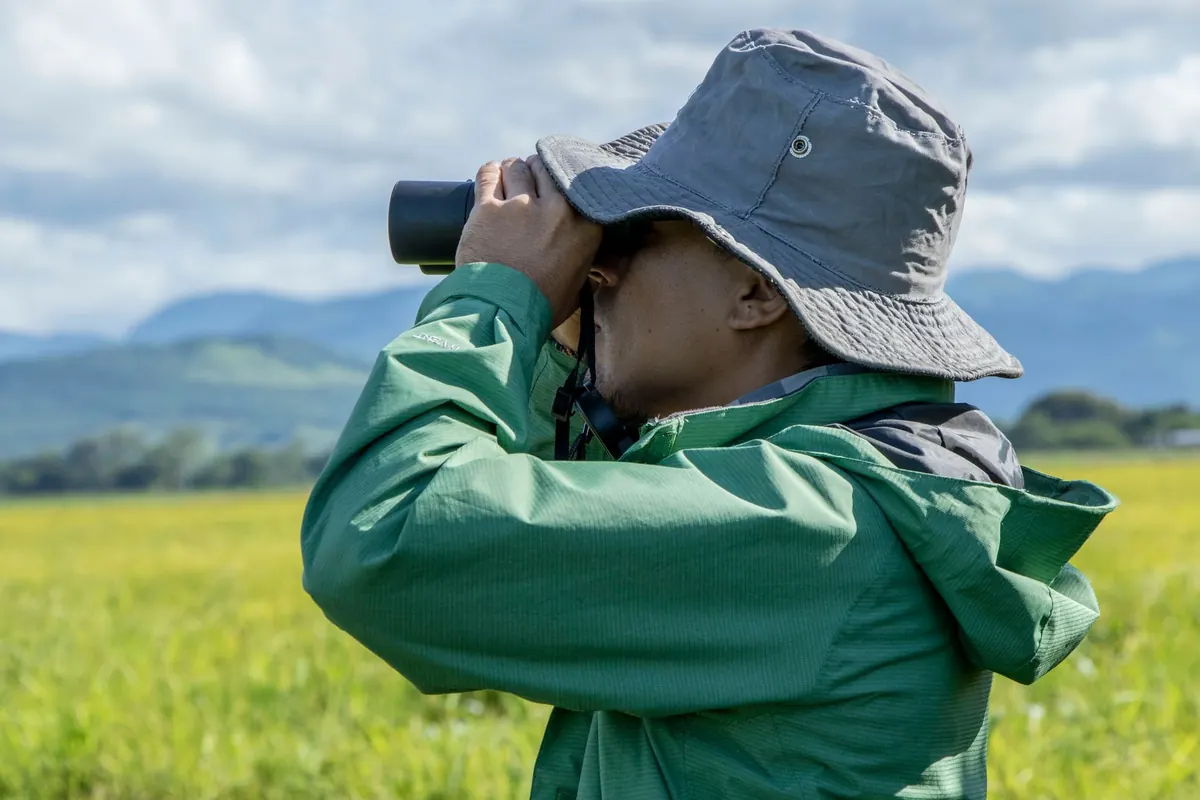
The first time a decent pair of binoculars lands on a wren, the hobby changes. A brown blur in the hedge becomes a bird with a barred tail, a cocked attitude and a surprisingly loud opinion about your presence. Before that, most of us squint at something small and hope.
You do not need to spend a fortune to get there. You need to understand the handful of numbers printed on the side of every pair, and know which ones actually affect what you see.
Magnification: why more is usually less
Magnification is the first number: 8x, 10x, 12x. It tells you how many times bigger the bird appears. It sounds like the obvious thing to maximise. It is not.
Every step up in magnification narrows the field of view, shrinks the depth of field and amplifies every wobble in your hands. A 12x pair is harder to hold steady than an 8x, and the bird you cannot find in the viewfinder is worth nothing at all. That is why experienced birders overwhelmingly settle on 8x or 10x for hand-held use.
Choose 8x if you want the steadiest image, a wider view for picking birds out of cover, and a lighter pair round your neck. Choose 10x if you spend a lot of time on open water, estuaries or distant raptors and are happy to trade some field of view for a closer look. Anything above 10x belongs on a tripod.
Objective lens size and low light
The second number is the diameter of the front lens in millimetres. So an 8x42 has eight times magnification and 42mm objective lenses.
Bigger front lenses gather more light and generally give a brighter, more comfortable image, especially at dawn, dusk and under woodland canopy. Divide the objective size by the magnification and you get the exit pupil — the width of the light beam reaching your eye. An 8x42 gives a generous 5.25mm; a 10x25 compact gives 2.5mm, which is why pocket binoculars feel dim and fiddly.
The trade-off is weight and bulk. A 42mm pair is a sensible all-rounder for most UK birding. If you walk long distances or want something for a coat pocket, an 8x32 or even an 8x25 will earn its place, provided you accept the drop in low-light performance.
Field of view and close focus
Field of view is quoted as a width in metres at 1,000 metres, or in degrees. For an 8x42, look for at least 110 metres at 1,000 metres; 130 metres or more is genuinely pleasant. A wide view makes it far easier to follow a flitting warbler or a flock of waders, and much easier to find a bird you spotted with your naked eye.
Close focus is the minimum distance at which the binoculars will focus. A pair that focuses down to two metres is useful. One that goes to 1.5 metres or closer is a small joy: you can watch a dragonfly on a reed, a bee on a foxglove, or the birds on your own garden feeder without stepping backwards.
Eye relief, eyecups and glasses
If you wear glasses, eye relief matters more than almost anything else. It is the distance from the rear lens to the point where the full image forms — quoted in millimetres. Under about 15mm and you will find yourself pressing the lenses against your spectacles. Around 18mm is comfortable. Twist-up eyecups help you set the right distance quickly and should stay put when you press them against your brow.
Whether or not you wear glasses, you will need the dioptre adjustment, usually a ring on the right eyepiece. Set it once by closing your left eye and adjusting until the right side is as sharp as the left. Every pair feels different, so do this before you decide a binocular is soft.
Waterproofing and build quality
British weather is not optional. Look for binoculars described as waterproof and nitrogen or argon purged — that means sealed with O-rings and filled with dry gas so the inside does not fog up when you come in from the cold. "Water resistant" is not the same thing, and a damp autumn will find the difference.
Rubber armouring protects against the inevitable knock on a gatepost. A smooth, well-damped focus wheel that turns easily with one finger is worth more than you would think, especially in cold weather with gloves on. Check the strap and case too; a good pair with a thin strap will annoy you every single outing.
What your money buys in the UK
Prices move with sales and model changes, so treat these as rough bands rather than fixed rules.
- Under £100: usable, and often bright in good daylight. Expect compromises on eye relief, edge sharpness, close focus and sealing. Fine as a spare pair for a child or the car.
- Roughly £100–£200: the sweet spot for a first serious pair. You should get waterproofing, phase-coated roof prisms, decent close focus and a comfortable view.
- Roughly £200–£400: a clear step up in colour rendition, brightness and build. Smoother focus, wider field of view, lighter bodies.
- £400 and above: real quality, with subtle rather than dramatic gains for a beginner. Worth it if you are out several times a week.
Second-hand is a genuinely good route. A well-known model from ten years ago can beat anything new at the same price. Check for scratched lenses, internal haze or fungus, a stiff focus wheel and a missing eyecup, and buy from someone who will let you look through them first.
Two things to avoid: zoom binoculars, which are rarely sharp at either end, and cheap compacts advertising absurd magnifications. No 8x25 should claim 50x.
How to try before you buy
- Find a shop or an optics day at a reserve where you can take pairs outside.
- Look at a dim corner, not a bright window. That is where cheap glass shows itself.
- Read small text at distance. Sharpness should hold across most of the view, not just the middle.
- Test the close focus on a leaf or a sign a couple of metres away.
- Hold them one-handed and see how badly they shake.
- Wear them round your neck for ten minutes. Weight only becomes obvious later.
- Ask about the warranty and the returns policy before you pay.
Then go and use them
Buy the best pair you can comfortably afford, then stop thinking about specifications. Keep the strap short so the binoculars sit high on your chest, find birds with your naked eye first, then bring the binoculars up without taking your gaze off the spot. Brace your elbows on a gate, a fence post or your own ribs when you need steadiness. Clean the lenses with a proper cloth and a breath of air, not a shirt sleeve.
A modest pair that lives by the door and gets used on a Tuesday morning will show you far more than an expensive pair that stays in its case. Start with 8x42s, learn your local patch, and upgrade in a few years when you know exactly what you want.
Photo: Daly Selva Lira / Pexels